Hagerman Fossil Beds National Monument: Visitor Guide
How to visit Hagerman Fossil Beds National Monument: the new visitor center on US-30, the two overlooks, the Emigrant Trail, Oregon Trail ruts and tips.
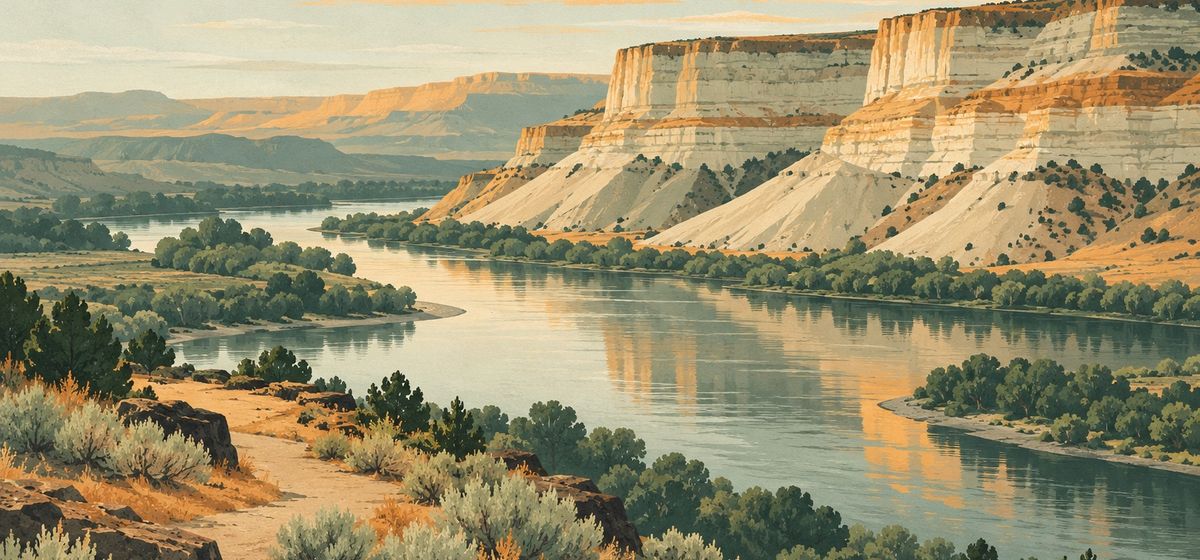
The bluffs on the west side of the Snake River near Hagerman hold one of the richest fossil records in North America. Hagerman Fossil Beds National Monument protects about 4,400 acres of those bluffs, where more than 200 plant and animal species from the Pliocene, roughly 3 to 4 million years ago, have been found. A visit has two parts in two different places: the visitor center on US-30, where the fossils are, and the overlooks and trail across the river, where the landscape is. Both are an easy outing from Hagerman RV Village.
What is Hagerman Fossil Beds National Monument?
Congress established the monument in 1988 to protect the fossil-bearing bluffs, which rise about 600 feet above the river. The same year, Idaho named the Hagerman Horse its state fossil.
The story starts in 1928, when Hagerman rancher Elmer Cook noticed bones eroding out of the bluffs along the Snake River. He showed them to a U.S. Geological Survey geologist, who passed word to the Smithsonian Institution. Smithsonian paleontologist J.W. Gidley led four expeditions here in 1929, 1930, 1931 and 1934. His crews blasted into the bluffs and scraped away sediment with teams of horses, digging as deep as 60 feet. They recovered more than 200 Pliocene horses, including over 20 complete skeletons.
The Hagerman Horse
That species, Equus simplicidens, lived about 4 to 3 million years ago and is an early relative of modern horses. The National Park Service describes it as a zebra-like ancestor of today’s horse. The Hagerman Horse Quarry remains the largest single find of the species anywhere, and it is now a National Natural Landmark inside the monument.
Research still goes on. The park runs a working paleontology lab, and field work continues at more than 600 fossil sites, with over 40,000 specimens collected so far. Most new finds come from the surface, not from a dig.
Where is the visitor center?
The visitor center has moved, and older signs, guidebooks and map apps may still point you to the old one. The monument now shares the Thousand Springs Visitor Center at 17970 US Hwy 30 with Thousand Springs State Park. It sits about a mile north of downtown Hagerman, on the same highway as the park. The NPS advises entering that exact street address in your navigation app, because a general search for the monument can send you to the wrong place.
This is the only place in the monument where you can see fossils. Inside are fossil displays and replicas you can handle, a small gift shop, restrooms and a water bottle filling station. Rangers give talks, and kids can pick up a Junior Ranger booklet. The center also has maps and information for the state park units nearby, which makes it a good first stop for planning the rest of your stay.
Hours vary by season. Check current visitor center hours on the NPS website before you go.
The overlooks and the Emigrant Trail
The monument’s overlooks and trail are on Bell Rapids Road, across the river. There is no public access to the fossil beds themselves, no quarry or dig site to visit, and no fossils on display in the field. What you get instead is the open country the fossils came out of, with wide views of the river valley.
Getting there: from the visitor center, head south on US-30 through Hagerman and across the Snake River, about 6 miles. Just after the bridge, turn right onto Bell Rapids Road and follow the signs for the monument.
Snake River Overlook
About 2.5 miles up Bell Rapids Road, the first overlook looks out over the river, the town and the bluffs. It has a vault toilet, a covered picnic shelter and one of the two trailheads for the Emigrant Trail.
Oregon Trail Overlook
About 2.5 miles farther on is the Oregon Trail Overlook, the end of the public road. Emigrant wagons heading west cut deep ruts into the loose, sandy soil here, and you can still see them from the overlook and along the park road. Wagon trains rested in the Hagerman Valley, where the river came out of its canyon and fresh springs flowed. This overlook also has a vault toilet and a covered picnic shelter.
Hiking the Emigrant Trail
The Emigrant Trail links the two overlooks and roughly follows the old wagon route. Per the NPS trail page:
- Length: 3.25 miles one way.
- Elevation: about 600 feet of gain going up from the Snake River Overlook, with a steepest grade of 21%. Start at the Oregon Trail Overlook for a mostly downhill walk.
- Surface: packed soil and hard gravel, about 4 feet wide, with loose rocks and animal burrows in places.
- One way or out and back: with two vehicles you can leave one at each trailhead.
There is no shade anywhere on the trail. Hot weather and strong wind are common much of the year, and the trail can be muddy or snowy in winter and early spring. If you only have half an hour, the overlooks alone are worth the drive.
Know before you go
- Fees: there is no entrance fee for the monument. Donations are welcome. Note that the nearby Idaho state park units do charge a vehicle entry fee.
- Hours: the overlooks and trail are open sunrise to sunset, even when the visitor center is closed. Visitor center hours change by season.
- Water: the only drinking water is at the visitor center. Bring plenty for the overlooks and trail.
- Dogs: pets are not allowed on any trails in the monument. Leashed pets may go on the park road and paved walkways. Service animals are allowed wherever visitors can go.
- Rattlesnakes and ticks: this is rattlesnake country. Stay on the trail, and if you meet a snake, back away slowly.
- Leave it where it is: digging and collecting rocks or fossils is not allowed, and that includes moving fossils you spot on the surface. Where a fossil lies can matter as much as the fossil itself.
- No dinosaurs: the fossils here are 3 to 4 million years old, long after the dinosaurs died out.
- Getting to Hagerman: coming on I-84, the NPS directions use Exit 141 from the west and Exit 155 from the east. For RVs, skip Exit 147 (Tuttle / Justice Grade Road), which is narrow and steep for rigs. See our directions for the route to the park.
Pairing it with other stops
The visitor center covers both agencies, so it is easy to string the fossil beds together with other parts of the valley.
Malad Gorge, a unit of Thousand Springs State Park, is where the Malad River drops over stair-step falls into the Devils Washbowl and runs through a 250-foot gorge. A footbridge across the canyon is the best place to look down into it. Day use is open year-round.
Ritter Island, another state park unit, opens only in summer on limited days and hours. The road in is narrow and steep with very little parking and no turnaround, so the state advises against bringing a motorhome or trailer. Drive over in your tow vehicle or car.
After a hot afternoon on the bluffs, many visitors finish the day with a soak; our Hagerman hot springs guide covers the options. To see the bluffs from water level, the Snake River kayaking guide covers routes and the local outfitters listed under rentals. For the best months to visit, see the seasonal guide to Hagerman.